
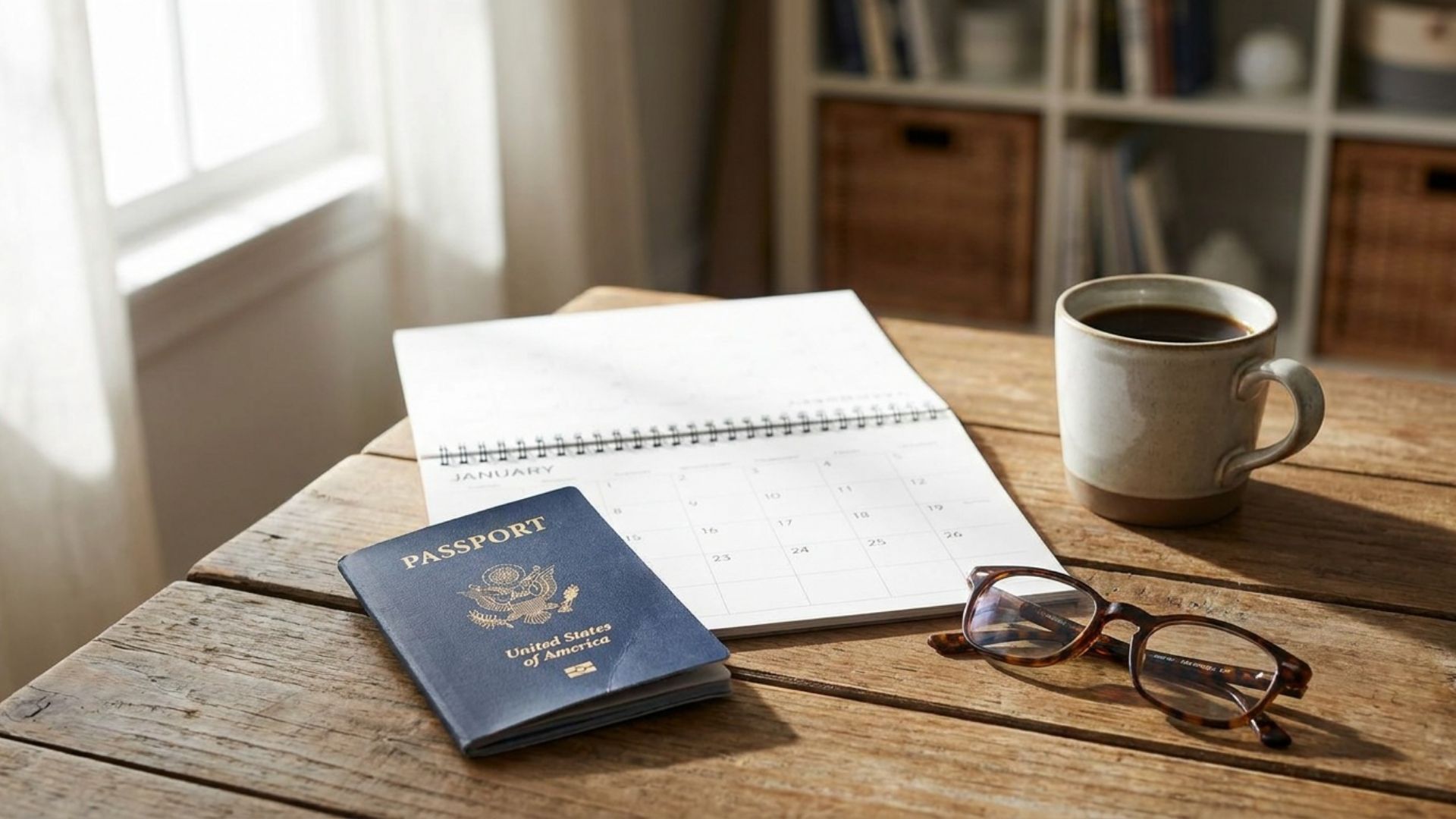
Why is January the right time to check your passport?
Travel planning has a rhythm to it. Flights get booked, hotels get reserved, and the passport — the one document that makes all of it legal — gets checked last, often the week of the trip. In an ordinary year that order is merely risky. This year, with passport application volumes climbing well past pre-pandemic levels and renewals taking far longer than travelers expect, that last-minute habit can quietly cost you a vacation.
January is the antidote. Your calendar is still mostly empty, no flights are booked, and nothing is on the line. A problem you find now is a quiet errand. The same problem found in May, with a booked trip and a countdown running, becomes an emergency.
The check itself costs nothing and takes about five minutes. Find your passport — and do not just assume you know where it is or what it says. Actually hold it in your hand and open it. That small act of looking is the entire point. Most passport scrambles trace back to someone who was sure their passport was fine and simply never looked.
Which two things on your passport should you actually read?
Look at the expiration date. Then look at how many blank visa pages you have left. Those two facts decide whether your passport is ready for the year ahead.
The expiration date is the one that catches people, because of a rule most travelers have never heard of: the six-month validity rule. Many countries — across Europe, Asia, and beyond — require that your passport remain valid for at least six months after the date you enter. A passport that expires in October is effectively unusable for an international trip the following June. It looks valid. For travel purposes, it is not. Count six months back from the printed expiration date — that, not the date itself, is your real travel deadline.
Blank pages matter too. A number of countries will not admit you without at least two consecutive blank pages for stamps and entry visas. If your passport is nearly full from past travel, that calls for a renewal — not something to discover at a border crossing. While you have it open, glance at the photo page and your personal details, and make sure nothing is torn, water-damaged, or unreadable. Officers can refuse a passport that is in poor condition, even when the dates are fine.
What should you do if the dates do not work?
If your passport expires within the next year, or you are down to a page or two, renew it now — while the calendar is still open and there is no flight depending on it. The first months of the year are the calmest, least crowded time to do it.
If you have already booked something and the timing is tight, that is where an expediting service earns its place. APVI has handled exactly these situations since 2003, and our specialists can move quickly when a deadline is real — in urgent cases, in as little as 24 hours. We are registered with the U.S. Department of State and work alongside the official process, not as a part of it.
One more step if you travel as a family: children's passports are valid for five years, not ten, so they expire on a faster cycle and drift out of sync with the adults in the household. Pull every passport in the house into one place and write the expiration dates on a single list. It is far easier to spot a problem on a list in January than at a check-in counter in July. Keep that list somewhere you will find it again next year — and if any date gives you pause, call us at (800) 766-0452. That is a conversation, not a crisis.