
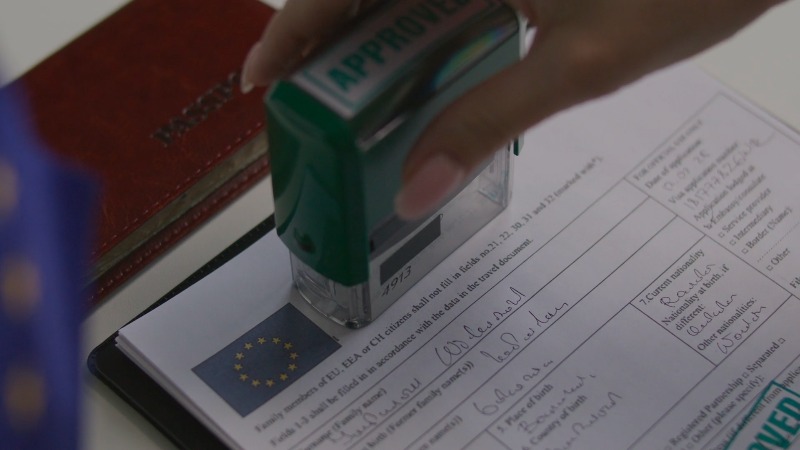
Why authentication is its own kind of work
Most of what APVI does is visible to the traveler. The passport renewal, the visa application, the urgent rescue — the traveler is in the loop, the document comes back, the trip happens. Document authentication is different. It is the quietest service we offer, the one most people only meet when they urgently need it, and the one whose timeline is the most easily underestimated.
The reason authentication matters is straightforward. A U.S.-issued document — a birth certificate, a marriage certificate, a diploma, a court document, a power of attorney — is automatically recognized as authentic inside the United States. The moment it crosses a border and needs to be accepted by another country's government or institution, that automatic recognition disappears. The foreign authority has no way to know, on its own, whether the document is genuine.
Authentication is what closes that gap. It is a chain of official certifications that confirms the document is real, so the destination country can accept it. When the destination is part of the Hague Apostille Convention, that certification takes the streamlined form known as an apostille. When the destination is not, the document moves through a fuller legalization process that often involves the country's consulate. Either way, it is its own kind of work, with its own rhythm.
The chain a document actually moves through
What makes authentication slower than people expect is not any single hard step. It is that the document moves through a sequence of offices, each with its own role and timing. Watching this from inside the work is what makes the importance of lead time obvious.
The first link in the chain is usually the issuing or notarizing office in the United States — the state or local authority where the document originated, or a notary attesting to a signature. From there, depending on the document type, it generally moves to the appropriate state-level authority for state-issued certification. For documents that need it, the chain continues to a federal-level authority, and for non-Hague destinations, on to the destination country's embassy or consulate for the final legalization stamp.
Each link is its own office, with its own pace. Nothing in the process happens at the airport or at the consulate's front counter. A document arrives, is reviewed, is certified, and moves to the next step — that is the rhythm, and it cannot be skipped without breaking the chain.
The work of an authentication specialist is to keep that chain moving correctly, in the right order, with the right form of each document at each stage. A copy where the original is required, a certificate that is too old, a notarization with a missing detail — any of these returns the document to its starting point. Front-loading the scrutiny is the entire job.
Why early is the real expertise
The honest takeaway from looking at this work from the inside is not glamorous. It is that authentication's most valuable expertise is not speed at the end — it is starting early, getting the form of each document right, and respecting the sequence.
If you have any plan that involves a U.S. document being recognized abroad — a wedding, study, work, adoption, a legal or property matter — treat authentication as a first-class item on your timeline, not a footnote. Ask early which documents will need to be authenticated, and which path applies for the specific country involved. Build the lead time for that chain of certifications into your schedule from the beginning.
The families and individuals who experience authentication as a calm step are simply the ones who learned about it early. The ones who experience it as a scramble are the ones who, entirely understandably, found out late.
That is what APVI's authentication desk does, day in and day out. We have handled apostille and full legalization since 2003, and we are registered with the U.S. Department of State and more than 90 foreign embassies — the offices this chain runs through. If you have a document that will need to be recognized abroad, or you are simply unsure whether you need an apostille or a fuller legalization, call us at (800) 766-0452. The earlier you call, the more cleanly this particular piece will go.